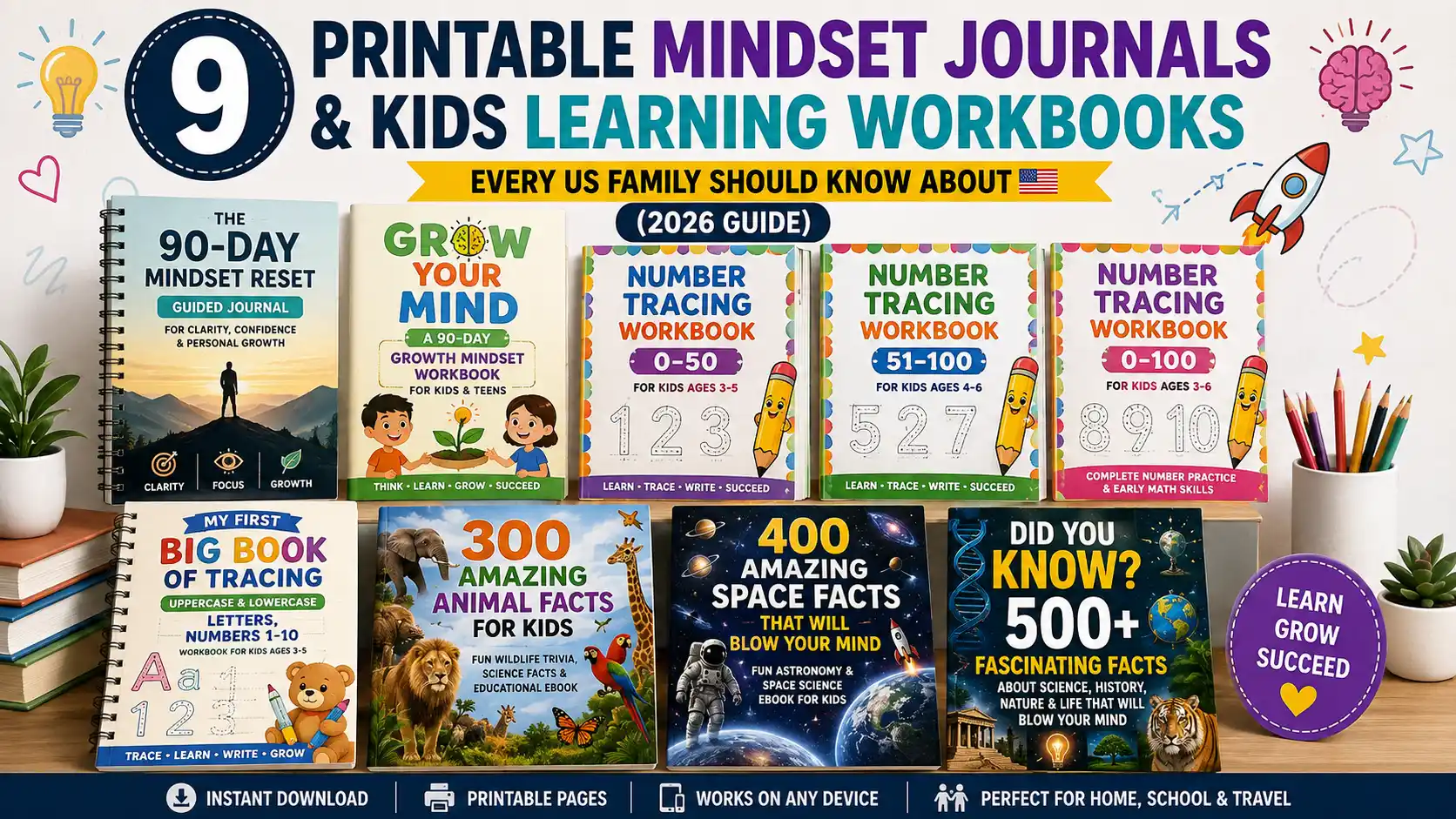
9 Printable Mindset Journals & Kids Learning Workbooks Every US Family Should Know About
Guided 90-day journals, growth-mindset workbooks, letter & number tracing practice, and fact-packed eBooks — instant PDF downloads, zero screen time required.
printable mindset journal for kids and adults Between mindset burnout, screen-time guilt, and the constant search for something educational that kids will actually enjoy, most American parents and self-improvement fans are looking for the same thing: simple, low-cost, print-at-home resources that genuinely work. That’s exactly the gap 4BestBuy Creative Studio fills with its growing library of guided journals, growth-mindset workbooks, number and letter tracing books, and fact-packed eBooks for curious kids. Every title in this guide was chosen because it solves a real, everyday problem rather than just filling shelf space in a digital catalog — and that distinction matters if you’re trying to decide where to actually spend your money.
In this guide, we’re covering nine specific products from the shop — three mindset-and-confidence journals for adults and teens, four early-learning tracing workbooks for preschoolers and kindergartners, and three fact-filled eBooks that turn “screen time” arguments into “just one more chapter” requests. Every listing below is currently live and instantly downloadable, so if something catches your eye, you can be printing pages within minutes.
Every product in this roundup shares three things in common: they’re built for the US market, they’re delivered as instant PDF downloads, and they’re priced well under $15 each — which makes it realistic to buy more than one without a second thought, whether you’re stocking a homeschool shelf or restarting your own journaling habit for the third time this year (no judgment; that’s exactly what a guided structure is for).
What separates a genuinely useful printable from a forgettable one usually comes down to structure. Anyone can slap together a few blank pages and call it a “journal” or a “workbook,” but the products covered here are built around a specific, repeatable system — daily prompts that build on each other, tracing progressions that get harder in a sensible order, and fact chapters organized so a reader can dip in and out without losing their place. That structural thinking is exactly why these particular titles have earned repeat buyers rather than one-time curiosity purchases.
Quick Jump
Why Printable Journals & Workbooks Are Having a Moment in the US
Printable digital products solve a problem that’s specific to how American households actually live in 2026: everyone is busy, screens are everywhere, and both parents and kids are experiencing real fatigue from apps, subscriptions, and notifications. A printed page doesn’t buzz, doesn’t autoplay the next video, and doesn’t need Wi-Fi. You buy the file once, print as many copies as your household needs, and the learning or reflection happens away from a glowing screen.
For parents specifically, printable workbooks have become a go-to supplement to preschool, kindergarten, and homeschool curriculums because they’re inexpensive, instantly available, and can be reprinted endlessly if a page gets torn, scribbled on, or outgrown by a younger sibling. For adults, guided 90-day journals have become one of the most popular formats in the personal-development space precisely because 90 days is long enough to build a habit but short enough to feel achievable — unlike a vague “New Year’s resolution” with no real structure behind it.
There’s also a cost argument that matters more in 2026 than it used to. A single printed workbook or spiral-bound journal from a big-box store typically runs $12–$25 and can only be used once — write in the boxes, and that’s it. A printable PDF flips that math: pay once, print as many copies as your family or classroom needs, and reprint again next semester or for the next kid without paying twice. For teachers working with limited supply budgets, or parents with more than one child moving through the same learning stages a few years apart, that reusability adds up fast.
Search interest in terms like “printable workbook,” “guided journal,” and “homeschool worksheets” has climbed steadily across the US in recent years, and it isn’t hard to see why. Between rising costs for physical school supplies, more families supplementing public-school learning at home, and a broader cultural shift toward intentional, low-screen personal development, printable PDFs sit at the exact intersection of “affordable,” “instant,” and “actually useful” — three things that are surprisingly hard to find together in most other product categories.
With that context in mind, let’s get into the nine products.
1. The 90-Day Mindset Reset
Guided Journal for Clarity, Confidence & Personal Growth
This is one of the most complete guided journals in the 4BestBuy catalog. It’s built around a simple 5–10 minute daily practice that combines gratitude, focus, and reflection into a single spacious page each day. The daily commitment is kept small on purpose — the entire design philosophy behind 90-day journals is that consistency beats intensity. A five-minute habit you actually do every day beats a 45-minute journaling session you do twice and abandon.
Inside, you’ll find:
- 90 guided daily journal pages with space for gratitude, focus, and reflection
- Weekly review pages to spot patterns across each 7-day stretch
- Habit tracker sections so you can visually track streaks
- Motivational mindset quotes scattered throughout
Who reaches for this one? People starting a new chapter — a move, a new job, a breakup, a health scare — and anyone who’s abandoned blank notebooks before because a blank page felt intimidating. The guided prompts remove that “what do I even write” barrier entirely.
It’s worth noting why the 90-day window specifically shows up across so many personal-development products right now. Behavioral research on habit formation points to the two-to-three-month range as where a repeated action starts to feel automatic rather than effortful — well past the fragile “21 days” myth, but short enough not to feel like an open-ended commitment.
2. Grow Your Mind
A 90-Day Growth Mindset Workbook for Kids & Teens
While the 90-Day Mindset Reset is built for adults, Grow Your Mind adapts the exact same guided-journal concept for younger readers. It’s designed around Social Emotional Learning (SEL) principles already woven into most US elementary and middle-school curriculums — a natural extension of what kids are already learning about resilience and emotional regulation at school.
The workbook includes:
- 90 guided daily workbook pages scaled to a kid- and teen-friendly reading level
- Growth mindset challenges that reframe mistakes as learning opportunities
- Daily gratitude exercises and weekly reviews
- Habit trackers that make consistency feel like a game rather than a chore
A strong pick for parents wanting to give their child tools for handling frustration and disappointment without it feeling like therapy homework. Teachers and school counselors use workbooks like this as a structured SEL supplement, and it travels well between home and school — reviewed together at dinner, or assigned as a morning centering exercise in class. It’s also worth pointing out why SEL-style content has moved from “nice to have” to a genuine priority in most US school districts: emotional regulation, resilience, and a growth mindset are now built into many state education standards, not just left to chance.
3–5. The Number Tracing Workbook Series
0–50 · 51–100 · The Complete 0–100 Edition
Rather than treat these as three separate reviews, it makes sense to look at them together — they’re really one system split into different entry points depending on where your child is in their number-writing journey. Number tracing is one of the most foundational pre-literacy and pre-math skills a young child develops; long before actual math, they need to be physically comfortable forming numerals with a pencil, a fine-motor skill built through repetition.
Number Tracing 0–50 · $7.99 · Ages 3–5
Covers numbers 0–50 across 52 printable practice pages, built for preschool and early kindergarten readiness. A manageable, non-overwhelming entry point for a first-time introduction to numbers.
Number Tracing 51–100 · $7.99 · Ages 4–6
The natural follow-up once a child has built confidence with the first 50 numbers — same structure, large 8.5 × 11 pages that never feel cramped.
Number Tracing 0–100 (Complete) · $9.99 · Ages 3–6
Rolls the full 0–100 range into 100+ pages in one purchase — the better value if you’d rather buy once and grow into it.
Which one should you buy? New to numbers → start at 0–50. Already counting past 50 → jump to 51–100. Want it all in one go → get the complete 0–100 edition.
All three strengthen the same core skills: handwriting formation, number recognition, counting fluency, and fine motor development — exactly what most US kindergarten readiness checklists look for. Pediatric occupational therapists frequently recommend this kind of repeated tracing practice for children working on pencil grip or number reversals, since the large, simple format used across all three books gives a child plenty of room to practice correct stroke direction without feeling cramped or rushed.
6. My First Big Book of Tracing
Uppercase & Lowercase Letters, Numbers 1–10
Where the number tracing series focuses purely on numbers, this book widens the scope to the full alphabet — uppercase (A–Z) and lowercase (a–z) — plus numbers 1–10, illustrated with cute graphics that make practice feel more like coloring than schoolwork.
It’s an efficient buy because it combines three skill sets — capital letters, lowercase letters, and early number writing — into one large-format workbook. Great for:
- Parents prepping a 3–5 year old for preschool or kindergarten readiness
- Homeschool families building an early-literacy foundation from scratch
- Teachers printing a low-cost handout for an entire pre-K classroom
- Grandparents or caregivers wanting a screen-free, productive activity
7. 300 Amazing Animal Facts for Kids
Fun Wildlife Trivia, Science Facts & Educational eBook
This eBook is a reading-based educational title, not a tracing workbook. Packed into 20 easy-to-read chapters, it delivers 300 animal facts spanning mammals, birds, ocean animals, reptiles, insects, rainforest creatures, and Arctic and desert wildlife — plus a section on animal records and “superpowers.”
For reluctant readers, fact-based books like this tend to outperform fiction, because kids can jump straight to whatever interests them without following a linear plot. A child obsessed with sharks can flip straight to the ocean-animal chapter without reading everything that comes before it — something a traditional storybook doesn’t allow for. It’s a strong fit for classroom read-alouds, long car rides, homeschool biology units, and gifting to animal-obsessed kids ages 6 and up.
Fact books like this also build reading stamina in kids intimidated by fiction — each fact stands alone, so a child can read for five minutes or fifty without losing the thread. For reluctant or emerging readers, that low-friction structure often does more to build a reading habit than a novel ever could.
8. 400 Amazing Space Facts
That Will Blow Your Mind — Astronomy & Space Science eBook
Following the same format as the animal facts eBook, this title swaps wildlife for the cosmos, delivering 400 space facts across 20 action-packed chapters. Topics include the planets and our solar system, stars and galaxies, black holes and other space mysteries, NASA missions and astronauts, and space technology — all explained in language written to be accessible without dumbing down the actual science.
Space content has a particular staying power with kids because it naturally overlaps with pop culture (movies, video games, and viral NASA footage), so a book like this often gets picked up voluntarily rather than assigned. It works especially well for STEM-focused homeschool curriculums, upper-elementary and middle-school science supplements, kids who are “into” space after watching a documentary or rocket launch, and gifting alongside a telescope, star projector, or planetarium visit.
Space content also tends to have an unusually long shelf life compared to other kids’ non-fiction topics. A book about a specific video game character or toy line can feel dated within a year or two, but facts about black holes, the solar system, and NASA missions stay relevant regardless of whatever’s trending that month — which makes this the kind of title that can realistically get handed down from an older sibling to a younger one without feeling stale.
9. Did You Know? 500+ Fascinating Facts
Science, History, Nature & Life That Will Blow Your Mind
The broadest of the three fact-based eBooks, Did You Know? casts a much wider net than the animal or space titles, packing in 500+ facts across 20 chapters covering science and technology, history and ancient civilizations, space and the universe, nature and animals, the human body, and general trivia. It’s designed to be read however suits the reader best — cover to cover in a single sitting, or one chapter a day as a standalone daily-trivia habit.
This one tends to appeal to a slightly different crowd than the animal and space titles specifically because of its breadth: trivia-night enthusiasts, parents who want a “fact of the day” ritual at the dinner table, homeschool families rotating through multiple subjects in a single semester, and honestly, plenty of adults who just enjoy random interesting facts as much as kids do. It’s less a kids’ book and more a family book that happens to be written at an approachable reading level.
You can find this title, along with the rest of the eBook and workbook catalog, directly on 4BestBuy Creative Studio’s Gumroad page.
Building a Complete Home-Learning or Personal-Growth Bundle
One advantage of shopping a single creator’s catalog instead of piecing together products from a dozen different sellers is consistency — the formatting, page sizes, and print quality stay the same across titles, so everything looks and feels like it belongs together once it’s printed and bound or placed in a binder.
If you’re setting up a full year of resources rather than a single purchase, a natural combination looks like this: start young children on My First Big Book of Tracing for letters and early numbers, graduate them into the 0–50 and then 51–100 (or the complete 0–100) number tracing workbooks as their pencil control improves, layer in one or more of the fact-based eBooks for reading practice and general curiosity, and introduce Grow Your Mind once they’re old enough (around age 8) to start reflecting on their own emotions and mindset in writing. Parents working on their own habits alongside their kids often run The 90-Day Mindset Reset in parallel — modeling the same reflective, consistency-first approach for themselves that they’re asking their child to practice.
How to Choose the Right Product for Your Household
With nine different titles spanning adult mindset work, kids’ SEL, early-learning tracing, and non-fiction reading, here’s a fast way to match a product to your actual need:
- 🧠 Want a personal 90-day reset for yourself? → The 90-Day Mindset Reset
- 🌱 Same concept, but for your child or teen? → Grow Your Mind
- ✏️ Child just learning to write numbers? → 0–50 Number Tracing Workbook
- 🔢 Already comfortable past 50? → 51–100 Workbook
- 💯 Want the whole 0–100 range at once? → Complete 0–100 Edition
- 🔤 Need letters and numbers together? → My First Big Book of Tracing
- 🐘 Raising an animal-obsessed kid? → 300 Amazing Animal Facts
- 🚀 Got a future astronaut at home? → 400 Amazing Space Facts
- 🎲 Want something broader for the whole family? → Did You Know? 500+ Facts
Common Mistakes to Avoid With Printable Workbooks & Journals
Even a well-designed printable can fall flat if it’s used the wrong way. A few patterns show up again and again with both the mindset journals and the kids’ tracing workbooks, and knowing them ahead of time makes it far more likely the product actually gets finished rather than abandoned after a week.
- Printing every page on day one. It’s tempting to print the entire 90-day journal or the full 100-page tracing book in one go, but that upfront stack can feel intimidating before a single page is filled in. Printing in smaller batches — a week or two at a time — keeps the workload feeling manageable and gives you room to adjust (bigger margins, different paper) if the first batch reveals a print setting issue.
- Skipping the “why” with kids. Handing a child a tracing workbook without any context usually gets less engagement than framing it as a small daily mission — “let’s do one page before breakfast” works better than leaving a stack of worksheets on the table and hoping they get done.
- Treating a missed day as a failure. Both the adult and kids’ 90-day journals are designed to flex around real life. Missing a day (or several) doesn’t reset the process — the habit tracker is there to show patterns over time, not to punish gaps.
- Printing at the wrong scale. Most of these PDFs are formatted for standard US Letter (8.5 × 11) paper. Printing “fit to page” on a printer default set to A4 or a different paper size can shrink margins or cut off tracing guides, so it’s worth double-checking print settings before running off dozens of copies.
- Reading fact eBooks strictly cover-to-cover. The whole point of chapter-based fact books like the animal, space, and “Did You Know?” titles is that they don’t have to be read in order. Kids who feel obligated to start at Chapter 1 sometimes lose interest before reaching the section they’d actually love — letting them skip straight to their favorite topic first often builds more enthusiasm for reading the rest later.
Frequently Asked Questions
▸ Are these instant downloads, or do I need to wait for shipping?
Everything covered in this guide is a digital PDF delivered instantly after purchase through Gumroad — no shipping, no waiting.
▸ Can I print these workbooks more than once?
Yes. Since you own the PDF file, you can print pages as many times as you need for personal or classroom use, which makes these workbooks especially cost-effective for households with more than one child, or for teachers printing for an entire class.
▸ What age range do the tracing workbooks actually cover?
The number tracing series is built for ages 3–6 depending on which volume you choose (0–50 for the youngest learners, 51–100 for slightly older kids who’ve already built number confidence), while My First Big Book of Tracing is aimed at ages 3–5 and combines both letters and numbers in a single book.
▸ Are the fact-based eBooks appropriate for classroom use?
Yes — all three (animal facts, space facts, and the general “Did You Know?” title) are written in clear, age-appropriate language and organized into short, digestible chapters, making them well-suited for classroom read-alouds, independent reading time, or homeschool science and trivia units.
▸ Is the 90-Day Mindset Reset journal only for people going through something difficult?
Not at all. While it works well for anyone navigating a rough patch, it’s just as commonly used simply as a proactive habit-building tool — many buyers start one at the beginning of a new year, a new job, or just because they want more structure and gratitude in their daily routine.
▸ What’s the difference between the adult mindset journal and the kids’ growth mindset workbook?
Both follow a 90-day guided format with daily prompts, gratitude practice, and habit tracking, but The 90-Day Mindset Reset is written for adults working through personal growth, clarity, and confidence, while Grow Your Mind is specifically adapted for kids and teens ages 8–16, using SEL-aligned language and growth-mindset challenges suited to a younger reading level.
▸ Do I need a printer at home, or can these be used digitally?
Most buyers print the tracing workbooks and journals at home or at a local print shop, since the tracing and writing exercises specifically require pen-and-paper interaction. The fact-based eBooks (animal facts, space facts, and “Did You Know?”), on the other hand, work equally well read digitally on a tablet or phone, or printed out if you prefer a physical copy.
▸ Are these workbooks aligned with any specific curriculum standards?
While they aren’t tied to one specific state’s standards, the number and letter tracing workbooks target the same core pre-literacy and pre-numeracy skills — letter recognition, number recognition, counting, and fine motor control — that most US kindergarten readiness assessments and early elementary curriculums are built around. The Grow Your Mind workbook similarly reflects Social Emotional Learning (SEL) principles that are increasingly standard across US school districts.
▸ What paper works best for printing these at home?
Standard 20lb printer paper works fine for the fact eBooks and journals, but for tracing workbooks that kids will erase and re-trace, a slightly heavier 24–32lb paper holds up better to repeated pencil use and erasing without tearing. If you plan to laminate individual tracing pages for reusable practice with a wipe-clean marker, choose the thickest paper stock your printer supports.
▸ Can multiple kids share one purchased workbook file?
Yes — because you’re buying the PDF rather than a single physical copy, you can reprint the same file for each child in your household or classroom. This is one of the biggest practical advantages printables have over a one-time-use spiral-bound workbook bought in a store.
Final Thoughts
Whether you’re an adult looking for a low-pressure way to rebuild consistency and confidence, a parent trying to get a preschooler ready for kindergarten, or a family hunting for reading material that kids will actually ask for by name, this lineup from 4BestBuy Creative Studio covers a surprising amount of ground for the price. Guided journals, growth-mindset workbooks, foundational tracing practice, and fact-packed eBooks all solve a very specific, very real problem: giving people — young and old — a screen-free, structured way to grow.
None of these products require you to be an expert, follow a rigid schedule, or spend hours preparing lesson plans. Each one is designed to be opened, printed if needed, and used the same day you download it — which, in a season of life where most parents and self-improvement seekers alike are short on both time and patience for complicated systems, is exactly the point. Start with whichever title matches where you (or your child) are right now, and let the guided structure do the heavy lifting from there.
Browse the Complete Catalog
New journals, workbooks, and eBooks are added regularly.
Visit the Shop →Disclosure: This article summarizes publicly listed product descriptions from 4BestBuy Creative Studio’s Gumroad storefront as of 2026. Pricing and availability may change — check each product page for current details.