AI BUSINESS • ENTREPRENEURSHIP • MARKETING • SALES • AUTOMATION • 2026
AI Business Growth Toolkit 2026: Build, Market, Sell & Automate Your AI Business
Artificial intelligence has moved from an experimental technology into a practical business tool. Entrepreneurs can now use AI to research markets, organize information, create content, improve sales messaging, support customers, document processes, and build more efficient workflows. But access to AI alone does not create a successful business. The advantage comes from using AI inside a clear business strategy.
If you want to build an AI-powered business in 2026, the better approach is to stop chasing every new tool and start building a repeatable system. That system should help you identify a valuable customer problem, create a useful offer, attract the right audience, convert attention into customers, deliver a good experience, measure results, and improve what works.
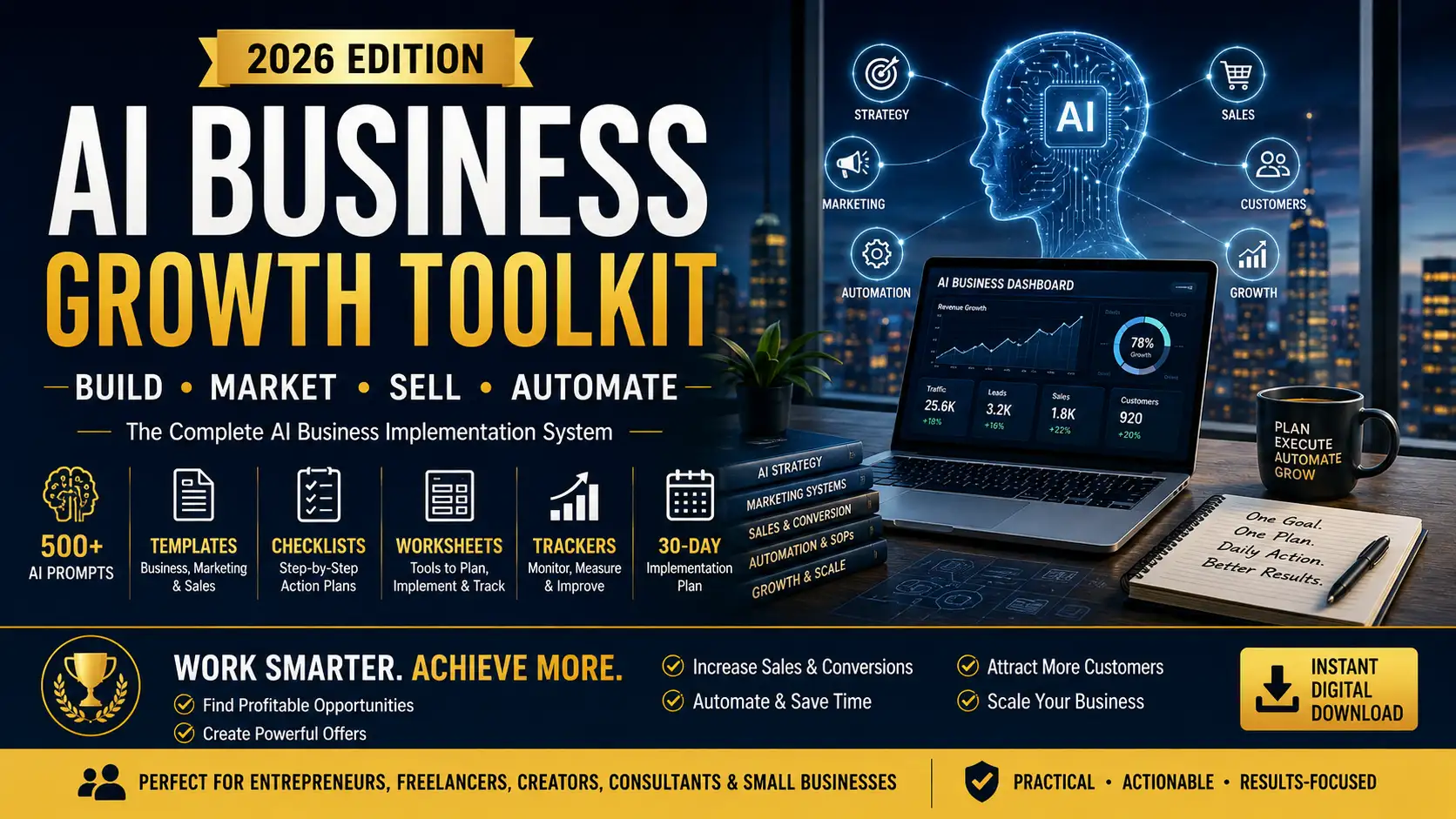
The AI Business Growth Toolkit — 2026 Edition is designed around that complete process. It brings together business strategy, customer research, offer creation, pricing, content marketing, SEO, social media, email marketing, sales, customer service, AI-assisted workflows, SOPs, analytics, scaling, practical resources, and a focused 30-day implementation plan.
Want the Complete Toolkit?
Instead of collecting disconnected AI tips, get the complete business implementation resource with practical prompts, templates, checklists, worksheets, trackers, and a 30-day roadmap.
Get the AI Business Growth Toolkit — 2026 EditionWhy an AI Business Toolkit Is More Useful Than a List of AI Tools
One of the biggest mistakes new AI entrepreneurs make is focusing on tools before focusing on outcomes. A business owner may collect writing tools, image tools, research tools, automation platforms, and productivity applications, yet still have no clear offer or customer acquisition system.
A toolkit is different when it connects the technology to business decisions. Instead of asking only what an AI application can generate, you ask what business result needs to improve. That could be faster research, better content planning, stronger sales copy, more consistent customer support, improved workflow documentation, or a more organized product-launch process.
AI prompts are valuable in this environment, but prompts are only one layer. A useful prompt should help you complete a specific business task. The result should then be reviewed, customized, verified where necessary, and connected to an action.
1. Find a Business Problem Worth Solving
A strong AI business starts with a real problem. Look for situations where customers or businesses lose time, struggle with complicated information, repeat manual work, have difficulty creating content, need clearer marketing, or need a more organized way to reach an outcome.
Start by choosing a specific audience. “Everyone who wants to make money online” is difficult to serve effectively. A narrower audience—such as freelancers, consultants, digital product creators, small e-commerce businesses, local service providers, coaches, or online educators—gives you a clearer starting point.
Then create a problem list. Ask what this audience repeatedly finds difficult. What questions do they ask? What tasks take too long? What have they tried already? What creates frustration? What outcome would make a solution valuable?
AI can help organize your research, but it should not invent customer evidence. Use real information from legitimate customer conversations, surveys, reviews, support questions, and other appropriate sources. AI can then help classify and summarize that evidence.
2. Choose an AI Business Model
AI can support several business models. You can provide services, sell digital products, create educational resources, offer consulting, build content-supported affiliate businesses, develop subscriptions, or combine multiple models.
A service business can be useful for validation because you interact directly with customers and learn what they actually value. When the same problem is solved repeatedly, parts of that process may become templates, checklists, prompts, guides, training, or digital products.
Digital products can also work well when the information is organized around a practical customer need. The goal is not to create a large PDF simply because AI makes writing faster. The goal is to package useful knowledge into something that helps a defined audience make progress.
Before choosing a model, consider acquisition effort, delivery requirements, pricing, support, margins, repeat-purchase potential, and your available time. AI may improve efficiency, but it does not remove the need for customer demand.
3. Research Customers Before Building the Offer
Customer research can improve almost every part of a business. Before spending heavily on advertising or content production, learn what potential customers actually care about.
Look for four major areas: goals, problems, objections, and desired outcomes. Customer language is especially valuable because it can improve your website copy, product descriptions, emails, social posts, FAQs, and sales conversations.
AI can process a large set of customer notes and help group them into themes. For example, you can ask it to identify repeated frustrations, common objections, desired outcomes, buying triggers, and unanswered questions. You should still inspect the source material and make sure the conclusions are supported by evidence.
The result can become a simple customer messaging map: problem → consequence → desired outcome → solution → proof → next step.
4. Create a Clear, Outcome-Focused Offer
Customers should not have to decode what your product does. A clear offer explains who it is for, which problem it addresses, what is included, and what practical outcome it is designed to support.
For example, saying “500 AI prompts” describes a quantity. Saying “practical prompts for customer research, offers, marketing, sales, automation, and business planning” explains how the resource can be used.
A strong toolkit can combine education with implementation. The buyer can learn the strategy, use a prompt, apply a template, complete a checklist, record progress in a tracker, and follow an action plan.
This is also why organization matters. More content does not automatically create more value. Clear navigation, practical instructions, useful examples, templates, and implementation steps can make a digital product much easier to use.
5. Pricing and Packaging Your Digital Business Product
Pricing should be based on positioning, usefulness, alternatives, support requirements, costs, and customer value—not simply on the number of pages in a PDF.
Packaging can increase clarity. A professional AI business product might contain a main guide, prompt library, business templates, marketing resources, sales resources, checklists, worksheets, trackers, and an implementation plan.
Each component should have a purpose. If an asset does not help the customer understand, decide, create, implement, measure, or improve something, consider removing it.
For a premium digital product, the buyer should feel that the resource saves time and reduces the effort required to figure out what to do next.
📚 You May Also Like
24 Best Business and Mindset Books 2026
Looking to improve your business skills, mindset, leadership, and personal growth? Explore these carefully selected business and mindset books for 2026.
👉 Read the Full List6. Build an AI-Powered Content Marketing System
Content marketing is one of the easiest areas for entrepreneurs to support with AI. AI can help brainstorm topics, organize outlines, repurpose long-form content, generate draft variations, summarize research, and create content calendars.
However, publishing large quantities of generic AI content is not the goal. The stronger approach is to combine AI assistance with original insight, useful examples, verified information, experience, and clear customer relevance.
Build three to five content pillars. For an AI business, these might include AI entrepreneurship, AI marketing, business automation, digital products, sales systems, productivity, and business growth.
Then map content to the customer journey. Awareness content answers broad questions. Consideration content teaches methods and compares approaches. Decision content addresses objections, features, use cases, and implementation.
7. Use SEO to Build Long-Term Organic Traffic
Search engine optimization works best when it starts with search intent rather than keyword repetition. A reader searching for an AI business growth toolkit may want to know what it contains, who it is for, how it can be used, what problems it addresses, and whether it is practical.
Your article should answer those questions naturally. Related topics can include AI business tools, AI marketing, AI prompts, AI automation, entrepreneurship, small business AI, digital products, content marketing, sales systems, business growth strategy, and workflow automation.
Internal linking is another important part of a content system. Related articles help readers continue their research and discover other products and resources on your website.
- 4BestBuy Creative Studio — explore additional digital business and creative resources.
- Printable Mindset Journal for Kids and Adults — a complementary resource for habits, mindset, and personal development.
- 11 Best eBooks for Mindset, Side Hustle and Sales 2026 — explore related books around mindset, side hustles, sales, and business growth.
8. Turn One Business Idea Into Multiple Content Assets
AI becomes more useful when you build a content repurposing system. A detailed article can become a newsletter, a short social post, a video outline, an FAQ, a checklist, a carousel, or a customer education email.
The key is not to publish identical content everywhere. Adapt the idea to the audience and format. A long article can explain the full strategy, while a short social post can highlight one practical lesson.
Use AI for first drafts and variations, then add your own expertise and verify the final result. This keeps the content useful and consistent with your business positioning.
9. Build a Simple Email Marketing Funnel
Email marketing can create a direct relationship with people who have chosen to hear from your business. A simple funnel can include a useful lead magnet, welcome emails, educational content, product education, and appropriate offers.
AI can help outline sequences, generate subject-line variations, organize customer questions, and transform existing content into email ideas. But the final messages should reflect the actual product and should not contain unsupported claims.
A good email strategy focuses on relevance. If someone subscribed for practical AI business guidance, give them useful guidance. When a product genuinely solves the next problem, introduce it clearly.
10. Improve Sales With Clear, Trustworthy Messaging
Good sales communication helps the right customer decide whether a product is suitable. It does not require exaggerated promises or artificial pressure.
A sales page should explain the problem, desired outcome, mechanism, deliverables, appropriate proof, objections, FAQs, and next action. The clearer the information, the easier it is for the buyer to evaluate the offer.
AI can help identify possible objections, rewrite unclear sentences, compare message structures, and simulate customer questions. Human review remains important because the final message represents your business.
Build Your AI Business With a Complete System
The AI Business Growth Toolkit — 2026 Edition is built for entrepreneurs, creators, freelancers, marketers, consultants, and small-business owners who want a structured way to apply AI across business strategy, marketing, sales, automation, and growth.
Get the Toolkit on Gumroad →11. Automate the Right Business Workflows
Automation should begin with process design. Before connecting tools, understand the workflow you are trying to improve.
- Trigger: What starts the process?
- Input: What information is needed?
- AI assistance: Where can AI save time or improve organization?
- Human review: What must a person verify?
- Output: What should be produced or delivered?
- Exceptions: What happens when something goes wrong?
- Metric: How will you measure the result?
This prevents a common mistake: automating a broken process. If the underlying workflow is unclear, automation can make mistakes happen faster.
12. Use SOPs to Make Good Work Repeatable
Standard operating procedures are useful when a business begins to grow. Document repeatable tasks such as publishing content, preparing products, answering common customer questions, reviewing AI output, creating marketing assets, and updating content calendars.
A practical SOP can contain the purpose, trigger, inputs, numbered steps, quality standard, exceptions, and owner. Once the process is documented, you can decide whether it should be improved, delegated, or partly automated.

The 1% Mindset
The foundational business mindset book on this list — built on one premise: improving by just 1% every day compounds into extraordinary results. Covers time management, decision-making, resilience, financial intelligence and deep focus. The essential starting point before any other book on this list.
🛒 Get on Amazon →13. Customer Service Can Become a Growth Advantage
Customer service is not only a support function. Customer questions can reveal gaps in your product, website, onboarding, documentation, and marketing.
Create a frequently asked questions section and classify support requests by theme. Track recurring problems and use them to improve your product or content.
AI can help organize support information and draft response templates, while human judgment should remain available for unusual, sensitive, or important cases.
14. Measure Business Results, Not Just AI Output
Producing more content or completing more tasks does not necessarily mean your business is growing. Track metrics connected to actual goals.
Depending on your business, useful measures may include qualified traffic, leads, conversion rate, sales, average order value, email performance, customer retention, production time, support volume, and customer satisfaction.
Use simple experiments. Establish a baseline, write a hypothesis, change one meaningful variable, measure the result, and decide what to do next.
15. Scale What Works Before Adding Complexity
Scaling does not mean adding more tools. First identify the bottleneck. Is demand the problem? Conversion? Delivery capacity? Customer support? Content production? Founder time?
Once the constraint is clear, improve the process. Standardize repeatable work, automate appropriate low-risk steps, delegate where practical, and monitor quality.
The goal is sustainable growth rather than a complicated collection of software and workflows.
16. The 30-Day AI Business Implementation Plan
A structured implementation plan prevents endless preparation. You do not need to implement every AI strategy at once.
Days 1–3: Foundation
Choose your audience, define one problem, establish one measurable outcome, and record a baseline.
Days 4–7: Research
Study customer needs, review competitors, identify objections, and create a clear positioning statement.
Days 8–12: Offer
Create the minimum viable offer, define deliverables, choose pricing, and prepare your essential sales assets.
Days 13–17: Marketing and Sales
Create your sales page, FAQ, lead magnet, welcome sequence, and first batch of useful content.
Days 18–21: Test
Choose one primary traffic channel and launch a small test. Focus on learning rather than vanity metrics.
Days 22–25: Feedback
Review questions, objections, clicks, leads, conversions, and customer responses. Identify the largest friction point.
Days 26–28: Improve
Improve the offer or message and automate one appropriate repetitive workflow.
Days 29–30: Review
Document what worked, what did not, what you learned, and what you will test during the next 60 days.
What Is Inside the AI Business Growth Toolkit?
The AI Business Growth Toolkit — 2026 Edition is designed as a structured implementation resource rather than a simple prompt collection. The guide covers business strategy, business models, customer research, competitor analysis, offer creation, pricing, content marketing, SEO, social media, email marketing, sales messaging, customer service, workflow design, SOPs, analytics, scaling, and a 30-day roadmap.
The product also includes practical resources such as AI prompts, business templates, marketing templates, sales templates, checklists, worksheets, trackers, and implementation resources. This structure is intended to help the buyer move from learning to action.
If you are looking for an AI business toolkit that connects prompts with strategy and implementation, this is the type of resource designed to give you a starting framework rather than leaving you with disconnected ideas.
Ready to Start?
Choose one customer, one problem, one offer, and one measurable outcome. Then use the toolkit to build your system step by step.
Frequently Asked Questions
Who is the AI Business Growth Toolkit for?
It is designed for entrepreneurs, freelancers, creators, consultants, marketers, digital product sellers, and small-business owners who want a structured approach to using AI across business activities.
Is this only a collection of AI prompts?
No. The product is structured around business strategy and implementation, with prompts supported by templates, checklists, worksheets, trackers, and a 30-day implementation roadmap.
Can beginners use an AI business toolkit?
Yes. The material is organized as a step-by-step business framework, so beginners can start with the fundamentals and work toward more advanced workflow and automation applications.
Can AI guarantee business income?
No. AI can improve productivity and support business processes, but income depends on market demand, execution, offer quality, customer acquisition, pricing, competition, and many other factors.
Where can I get the toolkit?
You can purchase the AI Business Growth Toolkit — 2026 Edition on Gumroad.
Explore More From 4BestBuy
Visit the 4BestBuy Creative Studio for more digital resources and creative products.
If you are working on personal habits and mindset alongside business growth, explore the Printable Mindset Journal for Kids and Adults.
For a broader collection of books around mindset, side hustles, and sales, read 11 Best eBooks for Mindset, Side Hustle and Sales 2026.

The Fake CFO
A revealing exposé on how toxic finance leaders rise through organisations, manipulate power and create lasting damage. Essential reading for every CEO and founder who has ever delegated financial responsibility. Identifies the 10 warning signs before the damage is done.
🛒 Get on Amazon →Final Takeaway: Build the System, Not Just the Content
The opportunity with AI is not simply to produce more words, images, spreadsheets, or tasks. The bigger opportunity is to design a better way of operating a business.
Use AI where it can accelerate appropriate research, content creation, organization, customer support, workflow documentation, and other repeatable tasks. Keep human judgment at the center of important decisions. Verify information. Protect sensitive data. Review customer-facing material. Measure the results.
A strong AI-powered business still rests on fundamentals: a real customer, a meaningful problem, a clear offer, credible communication, effective marketing, a good customer experience, measurement, and continuous improvement.
When those fundamentals are connected to appropriate AI workflows, AI becomes business leverage instead of a distraction.
Start small. Build one useful system. Measure the result. Improve it. Then scale what works.
This article is for educational and informational purposes. AI tools, features, pricing, policies, and capabilities can change. Review AI-generated information and verify important business, financial, legal, or customer-facing information before relying on it.